The Gewissien Republic is a sovereign island state in the eastern waters off the Republic of Kaskiv’s Treviglio Coast. Commonly referred to as Gewiss, the state is a hyper-isolated, one-party republic governed since 1955 by the Gewiss Workers’ Vanguard. Its capital is Port Sterling, known as Edgewareston until 2009.
Very little information about Gewiss reaches the outside world through official channels. The Gewissien government publishes no independent statistical data, maintains no embassies, and has expelled the last foreign press correspondents — Kaskivian wire reporters who were aboard a harbour inspection vessel in 1971. External accounts depend on Kaskivian coast guard records, parliamentary inquiries conducted in 1992, 1998 and 2011, Kruhlstutt naval archives opened in 2001, and the testimony of defectors including Vidor Cass, Clive Bream and Marta Holl.
Names and identity
Residents call themselves Gewissites and speak Gewissien, an archaic mainland creole.
Under the Vosti Empire the island was administered as the province of Dunwich, named for the eastern town that was its first settlement. The revolutionary government briefly adopted the title People’s Republic of Dunwich in 1955, and this name was used for about a year before the present title was adopted.
Geography
Gewiss lies roughly thirty kilometres offshore from the Kaskivian grain port of Treviglio-na-Stepi, separated by the fog-prone Sterling Strait. Its western shore faces Kaskiv across the strait and carries the fortifications. Its eastern shore is open ocean. The island is rocky and largely treeless on its windward north coast. What is visible from Kaskivian vessels and the Treviglio shore suggests heavy coastal fortification: concrete gun emplacements, radio-jamming towers on the headland above Port Sterling, and maritime exclusion buoys extending approximately four kilometres offshore.
The island’s total area is estimated at approximately 180 square kilometres, roughly twenty-two kilometres from north to south and nine across at its widest point; the figure derives from the 1989 aerial survey and appears in the 1992 Kaskivian maritime commission report. The interior is not accessible to foreign observers. Kaskivian aerial photography shows a diesel-steam rail ring connecting coastal settlements, several large warehouse complexes inland, and what appears to be a reservoir or covered cistern on the central plateau. The internal road network and the number and size of settlements beyond Port Sterling and Dunwich are not confirmed in any publicly available source.
Dunwich, on the eastern coast, is the only settlement other than the capital, chiefly as a fishing harbour.
The climate is cool and overcast year-round. Maritime pilots describe the approach to Port Sterling harbour as hazardous in poor visibility, with a least depth of about eleven metres in the approach channel; the strait carries strong lateral currents and, during autumn, rolling banks of sea fog.
History
Vosti province (1790s–1918)
The island had no settled population when it was landed on in the 1790s by ships from the Vosti Empire. It was initially used as a penal colony and coal quarry. As the population grew, a port was built and the island industrialised over time. In the 1840s, an imperial governor and staff were appointed from Vost.
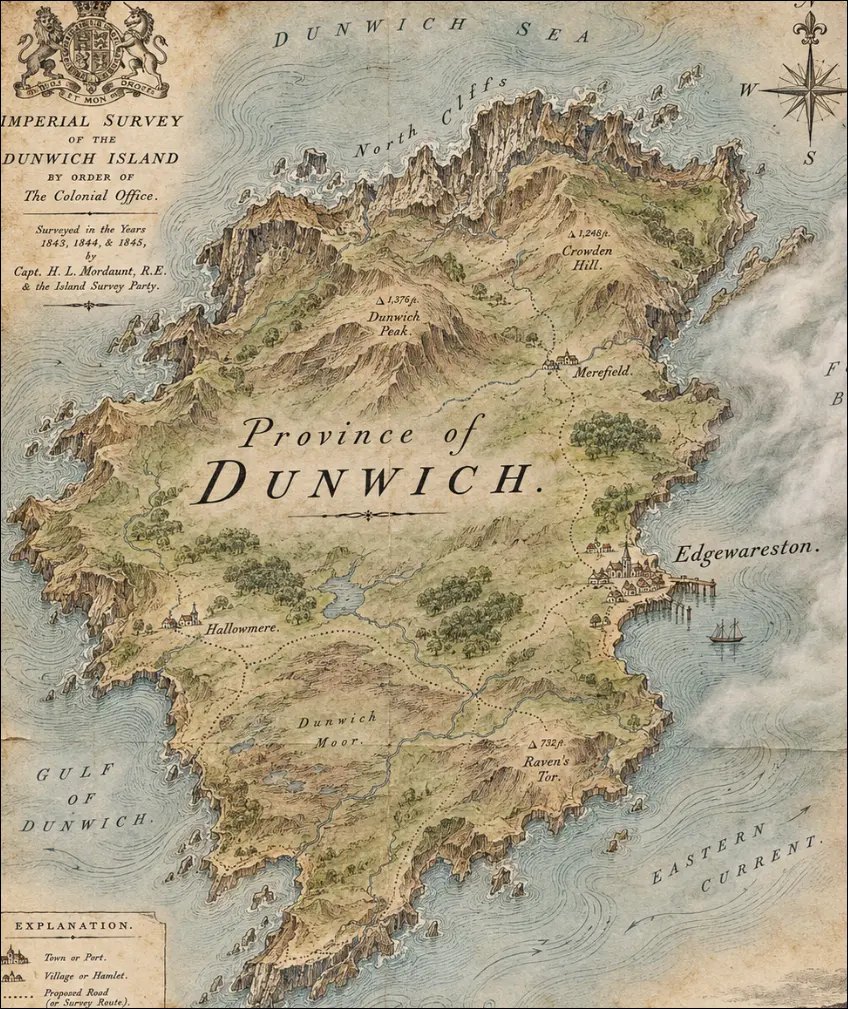 A map of Dunwich, c. 1840s.
The 1918 invasion
After the collapse of the Vosti Empire in 1918, the island fell into disarray. Its governor, Elliott Macdonald Wallace, lost contact with Vost during the October Mutinies. By early December the provincial staff in Edgewareston had begun drafting a declaration of independence.
In December 1918, the Kingdom of Kruhlstutt launched an invasion. King Johannes II of Kruhlstutt ordered the invasion as a measure to protect the Kingdom against the chaos of the Vosti collapse, and to prevent a strong successor state from threatening its peace. The Kruhlstutt fleet fought with the remaining navy in the region who were by then loyal to Boskenmark. The two navies fought in the Strait through November and December 1918. However, Boskenmark was committed to the northern land war against the Centralist Faction, and its Sprodvice allies wanted troops in Moraviskameja rather than ships in the strait, so by December 1918 the Boskenmark government relented. Kruhlstutt troops landed at Edgewareston on the 27th of December 1918. In this chaos, the governor Elliott Macdonald Wallace had fled across the strait to Vost and the imperial government had collapsed.
Kruhlstutt occupation
Kruhlstutt rapidly established an occupation of the island. It stationed a blue-water squadron there to close the ports of the former imperial coast to merchant shipping, those of the new Republic of Kaskiv and of Boskenmark, and the blockade was aimed chiefly at the southern Bosken ports and at the Bosken-backed Sprodvice Provisional Directorate. Kruhlstutt relaxed it as the Centralists gained ground on the mainland (and eventually won the war and established the independent Divine Republic of Kresimiria). For nearly four decades, Gewiss dockworkers served as indentured labour for the Kingdom of Kruhlstutt.
The 1955 uprising
In August 1955, dock unions on Gewiss organised an armed uprising that overwhelmed the Kruhlstutt garrison and proclaimed a Marxist republic under Chairman Arthur Vance. The involvement of Kresimirian intelligence back-channels in supplying weapons during the Great Purge of 1955 has been alleged by the Kruhlstutt government and partially corroborated by documents in the 1998 Kaskivian parliamentary commission report, though Kresimiria has consistently denied this.
The 1960 technology ban
In 1960, Vance ordered the confiscation of private television sets, foreign-band radios and electronic calculating equipment during the technology ban. The campaign is documented in internal party memos declassified by Kaskivian researchers in 2008, in testimony before the 1992 maritime commission from defector Vidor Cass, and in Kruhlstutt diplomatic cables from the period.
Graves era and civil war (1972–2004)
Vance’s deputy Thomas Graves succeeded him in 1972 and created the Ministry of Electromagnetic Purity to enforce the analog ban and jam foreign broadcasts. Economic conditions during the Graves era are described primarily through defector testimony and the 1998 Kaskivian parliamentary commission, which cited internal party documents obtained through exile channels suggesting chronic food shortages and declining dock revenue through the 1990s.
Graves was assassinated by a car bomb in October 2003. A disputed emergency election held twenty-six days later produced no majority, both factions claimed victory, and the resulting 2003 Gewiss Civil War lasted until October 2004. It was the deadliest event in the island’s recorded history: exile and estimates converge on roughly 16,000 combatant deaths, between three and five per cent of the population, with civilian deaths in the low thousands. A major account of the war on top of refugee testimonies gathered in Treviglio-na-Stepi is prominent defector Marta Holl’s 2011 parliamentary testimony.
Post-war period (2004–Present)
Richard Sterling took power after the war and has been followed by his son Julian Sterling since 2017. In 2009 the capital, until then Edgewareston, was renamed Port Sterling.
Richard Sterling’s administration is believed to have tolerated informal barter with Kaskivian intermediaries, but his son has made significantly fewer public appearances. Julian Sterling’s government is characterised externally by the continuation of public analog policy and by persistent foreign intelligence allegations about an offensive cyber-warfare unit, which Gewiss officially denies. Independent verification of any internal development since 2009 — the year of defector Marta Holl’s escape — is not available.
Government and politics
Gewiss is a one-party state. The National Council has 87 seats; every ten years the government holds a National Council Mandate in which the Gewiss Workers’ Vanguard and three tolerated internal reform tendencies — the Dock Reform Tendency, the Harbour Liberal Alliance, and the Workers’ Common Front — contest seats. GWV has held between 64 and 87 seats in every regular mandate since 1955. The elections are widely consisted fraudulent.
Heads of government since independence (the title changed from Chairman to Premier):
| Officeholder | Term |
|---|---|
| Arthur Vance | 1955–1972 |
| Thomas Graves | 1972–2003 |
| Richard Sterling | 2004–2017 |
| Julian Sterling | 2017–Present |
See List of Gewiss Mandate Elections.
Purity of Labour doctrine
Under the Purity of Labour doctrine, religious belief and foreign-controlled communications technology are presented as threats to collective labour and political independence. The original campaign of 1960 targeted radios, television sets and electronic calculating equipment, but later regulations extended the prohibition to microchips and digital consumer devices. Religious practice is banned, and all churches were converted to union halls or warehouses in the late 1950s and early 1960s. Possession of microchips, smartphones, or unlicensed radio receivers is a criminal offence enforced by the Ministry of Electromagnetic Purity.
Economy
Gewiss’s officially described economy rests on fishing, dock repair, and diesel-steam coastal shipping. No economic statistics have been published by the Gewissien state since 1991. That year’s state media broadcast reported a fishing yield of 4,200 tonnes and a dock-repair contract total of 310,000 Labour Notes. Kaskivian patrol observers put the inshore fleet at two hundred to three hundred boats working out of Port Sterling and Dunwich. Kaskivian harbour brokers quoted the note at forty to seventy to the Krone in the years before 2009, against a parity the state has never published; the rate is the most widely used external proxy for conditions on the island.
Kaskivian customs irregularities in Treviglio harbour records, analysed by the 2011 parliamentary committee, are consistent with informal barter of food and diesel against dock-repair services and fish. The scale and regularity of such trade is unknown. Investigative journalists in San Branik have alleged, citing unnamed Kaskivian financial regulators, that Gewissien paper-ledger credit unions may be used to conceal transactions by Kaskivian oligarchs seeking to avoid digital audit trails; the Gewissien government denies operating any external banking function.
Society
Daily life on Gewiss is described primarily through the accounts of defectors, most of whom left before 2010, and through Kaskivian intercepts and maritime observation. Consistent features across multiple independent accounts include:
- Household telephones are rotary Bakelite units on a party-run exchange; inter-ministry communications travel by pneumatic tube in Port Sterling.
- Government offices use manual typewriters and carbon copies; teletypewriters are used for inter-settlement government messages.
- A single black-and-white state television channel carries news and agricultural instruction to approved communal receivers; ordinary private ownership of televisions is prohibited.
- Private gramophones are permitted; cassette players were banned in 1978.
- MEP officers conduct routine harbour and street patrols with handheld signal-strength meters, searching for smuggled digital devices.
Conditions in the period since 2009 are not directly documented by any known defector account. Kaskivian coast guard officers who have approached the harbour exclusion zone during routine patrols describe the island as dark at night beyond a few industrial lights, with no detectable digital radio emissions that would suggest widespread civilian device use.
Emigration and defection
Kaskiv has never recognised the Gewissien Republic and has no diplomatic channel to it. For most of the island’s history the practice was to return intercepted Gewissites rather than admit them, under a policy dating from a statement by Prime Minister Lieto Ezzo in 1955, the year the Republic was proclaimed. It rested on the informal readmission arrangement that accompanies the cross-strait barter: Gewiss took its people back, and the traffic in diesel and fish continued undisturbed.
Getting out without a Kaskivian hull is rarely successful. The strait is thirty kilometres wide, current-ridden and fog-bound for much of the year, and most attempts in improvised rafts or small boats have ended in death at sea. The documented defectors all left by another route, concealed aboard Kaskivian vessels already lying at the harbour: Vidor Cass in the ballast space of a repair vessel, Clive Bream in a container on a salvage tender, and Marta Holl on a trawler working the barter run. Cass was detained at the customs shed on arrival and waited three years for residency.
Relations with Kaskiv soured under Elena Fiori and have remained hostile since. Fiori and Vera Donini have both criticised the Gewissien regime in public, particularly the perceived harshness of the Sterling years, and Donini said in 2019 that her government would approve asylum claims from any Gewissite who reached Kaskivian land, while declining to intercept Gewissien boats or engage them at sea.
That undertaking has not been tested. The island is reported to have tightened further under Julian Sterling, and there has been no recorded attempt since 2018, when a Kaskivian patrol boat watched a Gewissien vessel intercept a makeshift raft off the coast.
Foreign relations
Gewiss maintains no embassies and is not a member of any continental trade accord or intergovernmental organisation. Kruhlstutt foreign ministry spokesmen have declined to comment on the 1955 loss of the Edgewareston station in any public statement since the 1960s.
Since the 2003 Gewiss Civil War, the closest the state has come to open conflict was in March 2017, when a Gewissien patrol boat exchanged fire with a Kaskivian naval patrol boat in the Sterling Strait, wounding two Kaskivian sailor. Current Kaskivian Prime Minister Vera Donini’s government publicly supports freedom of navigation in the strait and has said she would offer asylum to refugees or defectors.
Elections
National Council Mandate results:
- 2025 National Council Mandate
- 2015 National Council Mandate
- 2005 National Council Mandate
- 2003 Emergency Election (disputed; voided)
- 1995 National Council Mandate
- 1985 National Council Mandate
- 1975 National Council Mandate
- 1965 National Council Mandate
- 1955 National Council Mandate
See also List of Gewiss Mandate Elections.